





Technical and Vocational Education and Training (TVET) is often discussed as a supply-side challenge. Curricula need updating, instructors need training, equipment needs modernizing, and delivery models need improving. While all of these matter, experience across regions suggests that they are only part of the story. In many contexts, perception itself is a binding constraint that shapes demand, investimento, and political will long before learners ever enter a classroom.
When TVET is seen as a “second-best” option, talented young people opt out even when labor markets are signaling strong demand for skilled workers. Families worry about limited mobility and long-term prospects. Employers may hesitate to trust credentials. Ao longo do tempo, this dynamic turns TVET into more than an education issue. It becomes a jobs, productivity, growth, and competitiveness challenge.
Making TVET a first-choice pathway is not about messaging alone. It is about building trust through quality, resultados, and real progression.
These themes were at the center of a recent discussion with the Asian Development Bank’s education and skills team, and they reflect a pattern seen repeatedly across countries and contexts.
The perception–system cycle
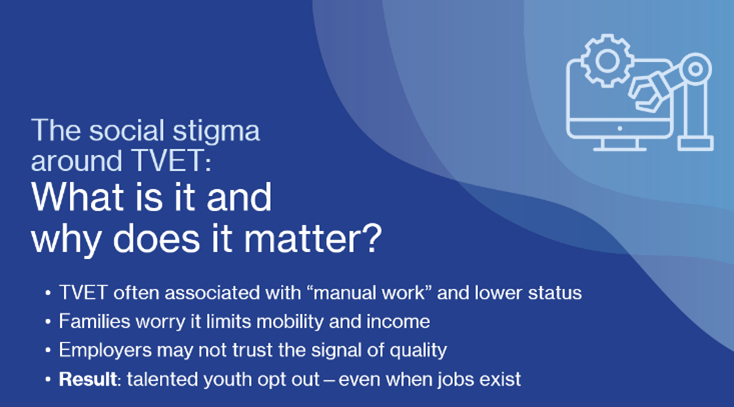
TVET stigma does not persist simply because of outdated attitudes. It is often reinforced by real system weaknesses. Fragmented governance, poor financing, uneven quality standards, limited work-based learning, outdated facilities, weak assessment systems, and most importantly lack of employer partnership, undermine trust in TVET credentials. Ao mesmo tempo, unclear or dead-end pathways make it difficult for learners to see how TVET connects to further education, career progression, or higher earnings.
These system gaps reinforce negative perceptions, which then reduce enrollment and political support. Lower demand leads to underinvestment, making it harder for providers to modernize or attract qualified instructors. Graduates may face underemployment or require retraining on the job, further weakening confidence in the system. The result is a self-reinforcing cycle in which perception and performance feed each other, to the detriment of learners, employers, and economies.
Breaking this cycle requires more than rebranding or communications campaigns. It requires coordinated system reform that improves outcomes and makes those outcomes visible.
What works: four levers that shift outcomes
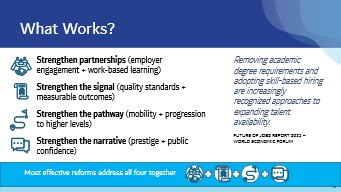
Evidence from diverse contexts suggests that the most effective TVET reforms address four interconnected levers together.
Primeiro, strengthen partnerships. Structured collaboration between government, training providers, and employers is essential. Sector coordination bodies, employer co-design of curricula, and high-quality apprenticeships or internships ensure that training reflects real labor market demand, builds employer trust, and removes dead-ends for graduates by offering a clear pathway to jobs and career progression.
Segundo, strengthen the signal. Clear quality assurance systems, including accreditation, avaliação, certification, and transparent outcomes data, give credibility to TVET credentials. When employers and families can easily understand what a qualification represents and how graduates perform in the labor market, trust increases.
Terceiro, strengthen the pathway. TVET becomes a first-choice option when it offers real mobility. Stackable credentials, recognition of prior learning, credit transfer, and clear bridges to higher education and/or labor market allow learners to progress rather than get stuck. Pathways should support reskilling and upskilling over a lifetime, not just initial entry into work.
Quarto, strengthen the narrative. Prestige follows performance. Public confidence grows when outcomes such as employment, wages, and progression are visible and credible. Career guidance grounded in labor market data helps families and students make informed choices, while governance and standards reinforce the message that TVET is a respected, high-quality pathway.
Critically, these levers work best when pursued together. Improving quality without pathways limits impact, and pathways without employer trust fall flat. Alignment is what shifts systems.
Why foundations matter
Strong TVET systems do not start with youth at age 15 ou 16. They are built on pre-primary and foundational learning that equip learners with the literacy, numeramento, and socio-emotional skills needed to access and succeed in vocational pathways. Weak foundations restrict who can benefit from TVET and exacerbate inequities, particularly for vulnerable learners.
As labor markets evolve due to technology, artificial intelligence, and the green transition, pathways must be flexible and inclusive. Foundational learning enables adaptability, making it possible for workers to move between roles, setores, and levels of training over time.
Implications for policymakers and development partners
For policymakers and development partners, the implications are clear. TVET investments should be framed not as narrow education interventions, but as system-strengthening and economic investments. Priority should be placed on reforms that improve outcomes, construir confiança, and create visible pathways to decent work.
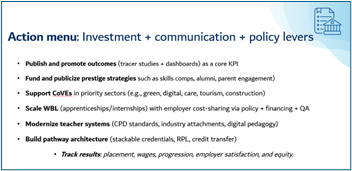
This includes financing centers of excellence in priority sectors, scaling quality work-based learning with clear standards and cost-sharing, modernizing instructor systems, and institutionalizing outcomes data through tracer studies and dashboards. Measuring what matters, including employment, earnings, progression, employer satisfaction, and equity, helps guide investment and sustain reform.
Making TVET a first-choice pathway is ultimately about trust. Trust built through quality, relevância, and systems that work for learners, employers, and economies alike, which will result in stronger employment outcomes, higher productivity, and more inclusive economic growth.
Creative TVET Staff Experts
Rebeca Pedra, EdD is a senior education systems expert with more than 20 years of experience providing technical assistance to governments and development partners to strengthen education quality, system coherence, and learning outcomes across low- e países de renda média, including work in Asia and in the Philippines. Her expertise centers on foundational literacy and numeracy, teacher workforce development, curriculum and assessment reform, and the translation of evidence into policy and practice at scale. Rebecca’s work focuses on the early and middle stages of the skills pipeline, recognizing that strong pre-primary and foundational learning systems are essential to equitable access to TVET, workforce readiness, and lifelong learning. She has led large, multi-country donor-funded programs and research initiatives supporting Ministries of Education to improve learning outcomes, strengthen institutional capacity, and build resilient education systems in fragile and conflict-affected settings. Currently serving as Senior Technical Director for Education at Creative Associates International, she oversees global education quality assurance, leads education thought leadership, and supports resource mobilization and policy dialogue with bilateral and multilateral partners. Her experience spans Asia, Central Asia, o Oriente Médio, África, and Latin America, and she brings deep expertise in evidence-based reform, multilingual education, and inclusive systems that advance productivity, equidade, and human capital development.
Salem Helali, PMP is a seasoned, multilingual expert in Technical and Vocational Education and Training (TVET), desenvolvimento de habilidades, labor market interventions, and private sector engagement, com mais de 20 years of experience leading policy, estratégia, and technical assistance across Asia and the Pacific, South Asia, Afeganistão, and Central Asia. His work focuses on strengthening the quality, relevância, and market alignment of TVET systems through industry-led approaches, labor market analysis, work-based learning, qualifications frameworks, and recognition of prior learning. Salem has designed and managed technical assistance at country, regional, and global levels, supporting governments, parceiros de desenvolvimento, and private sector stakeholders to respond to rapid labor market shifts driven by digitalization, the Fourth Industrial Revolution, demographic change, and the green and energy transition. Currently serving as Senior Technical Advisor for TVET and Workforce Systems at Creative Associates International, he leads and delivers large-scale, donor-funded technical assistance supporting TVET reform, desenvolvimento da força de trabalho, and youth employment, with experience across multiple ADB-relevant contexts and modalities. His work consistently emphasizes inclusive growth, equidade de gênero, and building agile TVET ecosystems that link skills. development to jobs and productivity. He works fluently in English, Farsi/Persian, Pashtu, Hindi, Urdu, with basic Arabic.
Tricia Tibbetts, EdD is the Vice President for Education and Workforce Development at Creative Associates. Ela tem mais do que 25 years of international development experience and specializes in strengthening ministries and departments of education and higher education to reach their development goals. Her experience includes leadership and education and workforce technical roles with Palladium, Salve as crianças, The World Bank, and USAID. In addition to leading teams, Tricia specializes in training and coaching education leaders to support inclusive education for learners and inclusive recruitment and continuous professional development for educators and education leaders. Tricia’s efforts have spanned central, south, and southeast Asia including Afghanistan, Bangladesh, Mianmar, Paquistão, Tadjiquistão, and Vietnam. Tricia holds a Doctorate of Education (dissertation: Resistance and change: a century of education reform in Vietnam) from George Washington University and a Masters of Education from Harvard Graduate School of Education.