




[vc_row][largeur vc_column = »1/1″][vc_column_text]
Lawrence Ndagije –A Self-Starter
[/vc_column_text][/vc_colonne][/vc_row][vc_row][largeur vc_column = »2/3″][vc_column_text]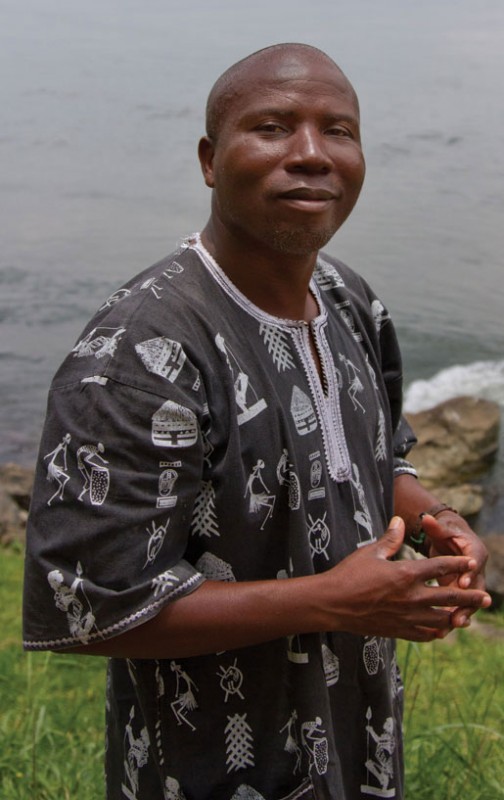 As a first time traveler to Uganda, one is first struck by the tropical sun’s brightness and the thousands upon thousands of people busily engaged in performing their daily tasks. These scenes play out all along the road, from a peasant woman tasked to sweep the dusty roads all day or, as in my case, witnessing the dedication of the staff at the USAID UNITY project. Parmi eux, I had the delight of working with Lawrence Ndagije, the project’s driver, sometime photographer and administrative assistant.
We are seated at an outdoor table at the Serena Hotel in Kampala struggling to speak above the deafening croaks of frogs and crickets. It strikes me that Lawrence has achieved a level of awareness about himself and the world that others might envy. He is one who looks forward, always forward, to a better tomorrow. “I am a survivor,” says Lawrence adding that his name means “God is my Savior.”
As an eight year old in his native Kisoro, Lawrence witnessed an unprecedented spectacle. Un jour, he heard the sky above him began to clank and whizz with the sound of choppers on the outskirts of town. Idi Amin’s soldiers had arrived to train as parachutists. Lawrence watched in awe as the men in parachutes came down from the sky. He too wanted to experience falling from the sky and before long had an idea. The next day he found a tall tree, climbed up it with an umbrella and jumped. “It was my fortune that someone had been digging the ground and had left a soft mountain of soil, so I survived the fall without breaking my legs.” Ironically, that incident has been something of a metaphor for his life.
Kisoro is in Western Uganda and as Lawrence is fond of noting his home region is green and dotted with terraces where peas, Irish potatoes, bamboo and many things are grown. “We have three mountains, lakes and gorillas. [Dans l'ensemble] Uganda is very beautiful. It has ten climates, people are friendly and it is a place where investments bring profits for Ugandans are hard working people.”
The eleventh of twelve children, Lawrence and his wife today are parents to five children. “My father was loved by all the villagers. He taught me to love people and to be honest. Even now, if I see something that is not right I will question it. It can be a problem to tell the truth, it may hurt you. Mais, in certain circumstances particularly those in which injustice is perpetrated on those least able to defend themselves, then it is necessary to speak truth to power.”
Often in high spirits tinged with a bit of anxiety, Lawrence takes his position as driver for the UNITY staff with utmost seriousness. He is a professional whose job performance is rated at nearly “99 percent” for consistent service to USAID’s BEPS Uganda project and UNITY, both projects implemented by Creative.
Navigating the streets of Kampala is no small feat. Except perhaps on a Sunday, the traffic is incessant all week long. A driver must negotiate endless traffic jams along with hundreds of mopeds, bicyclists and pedestrians all vying for the same space and with very few traffic lights. A persistent question for visitors in Kampala is how to find one’s way amid the maddeningly chaotic traffic while navigating to find an address in a sprawling city with so few street signs to guide either drivers or pedestrians. “Driving in Kampala is very stressful. A driver’s head must be like a computer, he must make sure his mind works within seconds,” says Lawrence. “But I like being a driver, a driver is someone who keeps all secrets and cannot reveal them. A driver hears and sees a lot. Thank God, I know the roads, I know even the potholes, when a U.S. team comes, they ask for Lawrence.”
Always planning for tomorrow, Lawrence is already thinking about how he will occupy himself when he retires from driving in a decade or so. “You see I have colleagues who are still driving at 55-60 ans, that’s poor planning,” says Lawrence. “When I retire, I will do something else. I am saving money now to start a small clinic with my son-in-law who is in medicine. If that does not work out, I plan to open a hardware store.”
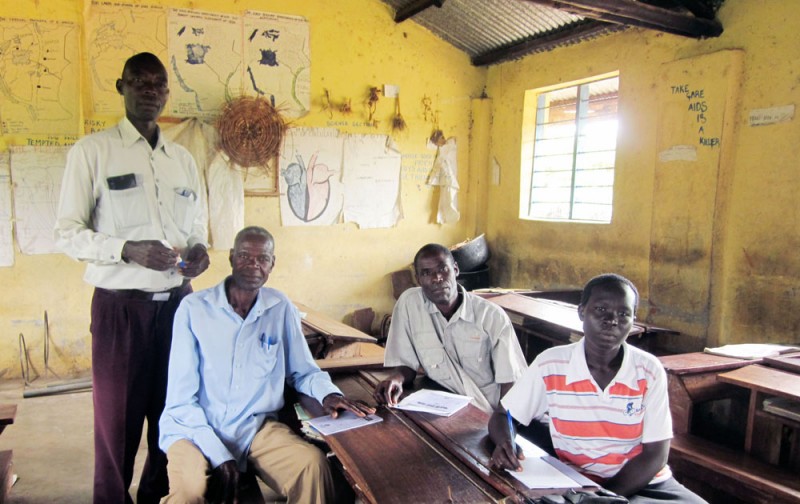
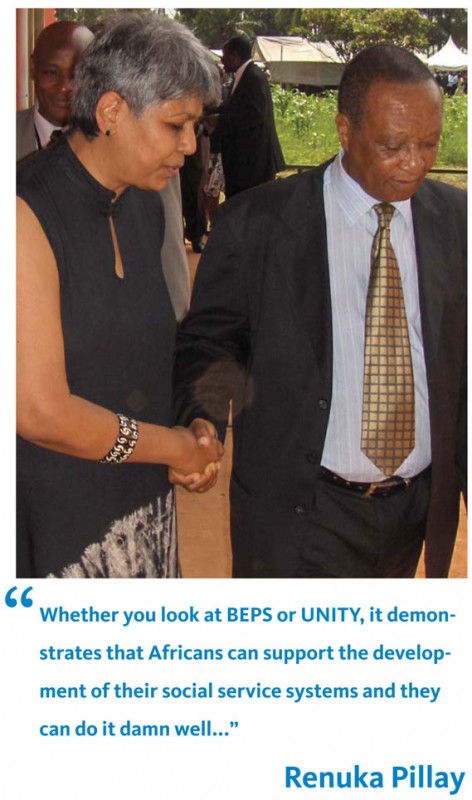
According to Lawrence his time spent as an employee of Creative has been a good experience. “Creative and its partners helped Uganda achieve international standards in our schools by training our teachers and putting in place policies for improving our education system.” Remarking on the imminent closing of the UNITY project in January 2012, Lawrence laments the project’s ending. “We have good [educational] materials from UNITY. We began working with a Special Needs Education policy, PIASCY is still going on, child-led activities. Project partners also supported Creative’s leadership. The credibility factor is significant in a country like Uganda where tribal patronage and nepotism erode confidence due to high corruption. BEPS and UNITY have stood above other projects because its workforce comes from different regions of the country. It’s not a family project with everyone from the one tribe. A diverse staff is key to the success of these projects.”
En tant que jeune homme, Lawrence made his way to Kampala from Western Uganda, like thousands of others migrating to the city from rural areas. A self-starter, Lawrence earned his driving permit in 1984. He notes that he has driven ministers and commissioners, even the Prime Minister of Uganda. “Each and every group I drove had children in secondary school. I would see them at lunch with their families, see their children, and I felt I had to do something for my children. I have dreams for my children. Donc, I worked very hard, sometimes with little to eat, so that I could send my children to better schools.”
His three oldest daughters have graduated from college; his fourth daughter is currently in high school. Lawrence’s “lovely” son Benedict is four years old. “I named him Benedict because of the pope – I liked Benedict when I saw a photo of all the potential popes, I picked Benedict and he was elected pope. God blessed me with my own Benedict.”[/vc_column_text][/vc_colonne][largeur vc_column = »1/12″][/vc_colonne][largeur vc_column = »1/4″][vc_widget_sidebar sidebar_id= »barre latérale-primaire »][/vc_colonne][/vc_row]
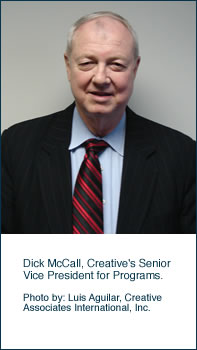 Reconstruire les États défaillants nécessite une bonne dose de diplomatie, mais sans institutions efficaces pour garantir l’état de droit et une citoyenneté engagée, les efforts sont voués à l'échec, dit Dick McCall, Vice-président principal des programmes de Creative.
 En avril, la Banque mondiale a publié son très attendu Rapport sur le développement dans le monde (WDR) 2011, le pionnier influent du développement. Notamment, le rapport s’écarte de l’orientation auparavant étroite de la Banque vers l’économie, qui jusqu’à présent servait de fondement aux objectifs internationaux de développement, surtout celui de la réduction de la pauvreté. Cela dit, la pauvreté reste un problème de développement insoluble. Le rapport indique que certains 1.5 Des milliards de personnes sont coincées dans un « piège de pauvreté » alimenté par les conflits., violence et gouvernance inefficace. Alors que le nombre de guerres civiles a diminué, la violence et les conflits restent largement un phénomène récurrent qui enracine 1 dans 4 les gens sur la planète dans un cycle sans fin de pauvreté. Le caractère récurrent de la violence entrave le développement économique, la sécurité et la justice dans les États touchés, les laissant incapables d’atteindre ne serait-ce qu’un seul des objectifs du millénaire pour le développement de l’ONU.. La question à un million de dollars est peut-être de savoir comment est-il possible 2011 que la piraterie – un problème de l’ère préindustrielle – persiste en raison du manque d’opportunités créé par le vide d’un État défaillant. Toujours, le rapport souligne que plutôt que de minimiser les efforts de la communauté du développement au cours des six dernières décennies comme une quête chimérique, il est plus productif d’examiner et de mettre en pratique les dures leçons apprises par le secteur afin qu’il puisse mieux servir les personnes mal desservies.. Le magazine Creative interviewe Stephen N, de la Banque mondiale.. Ndegwa, Conseiller, Unité des situations fragiles et affectées par les conflits et membre de l'équipe principale du WDR 2011, sur le changement critique dans la réflexion sur le développement international que propose le WDR.
 C'est une question difficile, parce que l'une des choses que nous exigeons est d'abord de très bien comprendre le contexte politique et ensuite d'évaluer la capacité des institutions à favoriser un climat dans lequel les décideurs sont responsables envers les citoyens et les groupes civiques qui, à leur tour, reconnaissent et acceptent leur légitimité à prendre des décisions. et mettre en œuvre les décisions pour le bien public. Les déclencheurs de conflits pourraient et/ou varieraient selon les circonstances. Un pays doté d'institutions assez solides en matière de gestion économique et d'allocation des ressources est moins susceptible de provoquer des réactions violentes parmi les citoyens, même si des inégalités existent entre les citoyens.. Prenons par exemple le litige 2000 élections aux États-Unis. Un conflit similaire déclencherait une fragilité massive dans la moitié des pays du monde. Mais aux États-Unis, 250 des années après l'indépendance, une résolution pacifique a mis fin à la crise en quelques jours sans ébranler le système dont les institutions sont très, très, très robuste. Maintenant, imaginez cette situation dans un pays qui n’existe que depuis 50 années, présente de profondes divisions ethniques ou régionales où les affiliations partisanes sont déterminées en fonction de l’appartenance à des groupes ethniques ou religieux spécifiques. Donc, pour concevoir un projet d'eau dans un tel endroit, nous souhaitons examiner les institutions locales disponibles pour résoudre les conflits qui peuvent survenir si un ou plusieurs groupes perçoivent que l'accès à l'eau est inégalement réparti parce que la distribution est basée sur des pratiques discriminatoires liées à l'identification ethnique ou religieuse.. Donc, si le gouvernement n'assure pas la sécurité, des groupes d'autodéfense apparaissent et ont tendance à se scléroser en gangs plus tard. Le fait est que la conception est spécifique au contexte et donc à la nécessité d'examiner les institutions en place afin de comprendre en temps réel et en termes historiques leur légitimité à administrer les programmes de développement afin que les bénéficiaires de l'aide ne recourent pas à la violence pour résoudre des conflits potentiels..
 Creative Associates International félicite l'USAID pour 50 des années de travail acharné au nom du peuple américain pour lutter contre la faim, pauvreté, désespoir et conflits dans le monde en développement, donner littéralement à des millions d’espoirs un avenir meilleur.