




[vc_row][vc_column][vc_column_text]
Salute to Tawakkol Karman, the Yemeni Nobel Peace Prize Winner
By Kawkab al-Thaibani
[/vc_column_text][/vc_column][/vc_row][vc_row][vc_column width=”2/3″][vc_column_text]
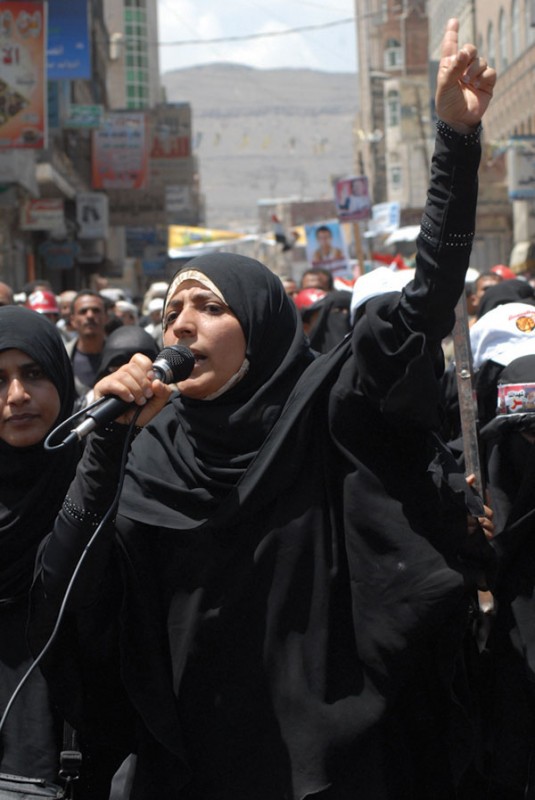 |
| Tawakkol Karman, Nobel Peace Prize Winner and Yemeni Human Rights adovocate. |
“I was always saying to Tawakkol, do not bring shame on us,” I recall Abdul-Salam Karman saying about his daughter Tawakkol who is the recipient of the Nobel Peace Prize. As he entered the tent to await his daughter, the tall slightly bearded Karman thought of his daughter, a human rights advocate who struggled for greater equality for Yemeni women. Tawakkol is one of the few women imprisoned in early February because she had been outspoken about the ouster of President Saleh.
“She is braver than me to call the president to leave,” continued, Karman, himself an influential politician for the opposition. His pride in Tawakkol is shared by the entire country which celebrates with this young Yemeni woman who has brought honor not only to Yemen, but to all Arabs as she is the first Arab female to win this prize.
Yemen is a hard country to understand and it is difficult to explain to the world how this country is great. We have in our history a tribal system with advanced laws regarding women. For example, it is widely believed that the Queen of Sheba, whose name in Arabic is Saba, a reference to the great kingdom of the Sabaeans which was situated in what is today Yemen. However, in recent history, women and their rights are marginalized following waves of religious extremism through the country.
But, today some women are standing up to win back their rights along with Tawakkol. She brings honor to me as a woman. Tawakkol brings honor to all Yemenis by showing the world that despite extremist voices Yemeni women can stand strong ready to reclaim their traditional status. Her courageous advocacy for restoring human dignity to Yemeni women was waged at great personal cost. Her house is destroyed and she had to leave behind her three children for a safe haven.
Tawakkol was once a fully veiled woman who grew up in a religious family. She married before she was twenty. As far as I know, Tawakkol is religious, but she is also reasonable and thus has never allowed dull religious opinions to control her life. As her understanding grew, Tawakkol cast off wearing her face veil and through symbolic gesture cast off the constraints of religious extremism. Thereby freeing herself to question and discuss openly some of the Islamic issues of our day. I remember once a colleague came back surprised that Tawakkol criticized some of the Islamic regulations.
Tawakkol receiving the Peace Prize comes at a time when the spirit of activists and their faith in peaceful protests is waning. The prize guarantees that the women’s rights will not be undermined. Our Nobel Peace prize winner’s aspirations for Yemen include a civil state where all people can live under the rule of law.
Tawakkol and fellow activists are to be saluted for forming a presidential council and daring attempt to find a way out of the country’s current situation. Alongside Tawakkol has been Khaled al-Anesi, Abdullah al-Sharif, Maizar al-Shariff, Abdullah Hathal and Mohammed al-Nahimi, her husband. This group knows no religion, race or any other affiliations; they are united by a common goal of bettering their country.
Khaled al-Anesi, her longtime friend and another front line activist deserves to be saluted for his support and encouragement to Tawakkol. Anesi is a seasoned attorney who left his job, family and camped with the other activists. Ali al-Sharif and Abdullah Hathal, two powerful men from Ma’rib, are also to be saluted for being there for the long struggle.
A big cheer goes to Mizar al-Junaid, a very brave activist from Ta’iz and one of the first people to call for change, and Abdul-Nasser al-Fuhaidi, an outstanding member of this unique group. We are at a time of great despair, fear, and loss, but we cry out for our country. Headed by Tawakkol, many supporters have marched to the palace to oppose the regime. They soon became a target of the opposition especially when they raised their voices in favor of the Gulf Council Countries’ initiative. I was always fascinated by the moral character and open-mindedness of the activists, and no wonder a Noble Prize winner was among them.
I also salute Tawakkol’s husband, who is always her staunch supporter. He is subject to harsh judgment; people say he cannot control his wife. He shares Tawakkol’s ambitions for Yemen as well as the sacrifices, which are the price one pays for freedom. Finally, salute to you Tawakkol for revealing to the world that Yemen is a county struggling to achieve peace. For Yemenis are a peaceful people.[/vc_column_text][/vc_column][vc_column width=”1/12″][/vc_column][vc_column width=”1/4″][vc_widget_sidebar sidebar_id=”sidebar-primary”][/vc_column][/vc_row]
 In April, the World Bank released its much awaited World Development Report (WDR) 2011, the influential trend-setter for development. Notably, the Report diverges from the Bank’s previously narrow focus on economics, which until now served as the underpinning of international development goals, especially that of alleviating poverty. That said, poverty remains an intractable development problem. The Report states that some 1.5 billion people are stuck in a “poverty trap” that is fueled by conflict, violence and ineffective governance. While the number of civil wars has diminished, violence and conflict are still widely a perennial occurrence that roots 1 in 4 people on the planet in an unending cycle of poverty. The recurrent nature of violence hampers economic development, security and justice in affected states leaving them incapable of achieving not even one of the UN’s Millennium Development Goals. Perhaps the million dollar question is how is it possible in 2011 that piracy – a problem of the pre-industrial era – persists as a result of the lack of opportunity created by the vacuum of a failed state. Still, the Report highlights that rather than discounting the development community’s efforts of the last six decades as a quixotic quest, it is more productive to look upon and put into practice the hard lessons learned by the sector so that it can better serve the underserved. Creative magazine interviews the World Bank’s Stephen N. Ndegwa, Adviser, Fragile and Conflict-Affected Situations Unit and Core Team Member of the WDR 2011, on the critical shift in thinking about international development that the WDR proposes.
 This is a hard one, because one of the things we push for is first to understand very well the political context and second to assess the capacity of institutions to foster a climate in which decision makers are accountable to citizens and civic groups who in turn recognize and accepts their legitimacy to make and implement decisions for the public good. The triggers for conflict could and/or would be varied in different circumstances. A country with fairly robust institutions in economic management and resource allocations is less likely to provoke citizens into violent reactions although inequality exists among citizens. Take for example the disputed 2000 elections in the U.S. A similar dispute would trigger massive fragility in half the countries in the world. But in the U.S., 250 years after independence, a peaceful resolution put an end to the crisis in a matter of days without shaking the system whose institutions are very, very, very robust. Now, imagine this situation in a country that’s only been in existence for 50 years, has deep ethnic or regional divisions where party affiliations is determined according to one’s membership in specific ethnic or religious groups. So, to design a water project in such a place we want to look at local institutions available to resolve conflicts that may arise if one or more groups perceive that access to water is distributed unequally because distribution is based on discriminatory practices related to ethnic or religious identification. So, if government doesn’t provide security, vigilante groups arise and they tend to ossify into gangs later on. The point is design is context specific and thus the need to examine the institutions in place in order to understand in real time and in historical terms their legitimacy to administer development programs so that aid recipients will not resort to violence to resolve potential conflicts.
 Creative Associates International congratulates USAID for 50 years of hard work on behalf of the American people in battling hunger, poverty, desperation and conflict in the developing world, giving literally millions hope for a better future.