




[vc_row][vc_column width=”1/1″][vc_column_text]
Lawrence Ndagije –A Self-Starter
[/vc_column_text][/vc_column][/vc_row][vc_row][vc_column width=”2/3″][vc_column_text]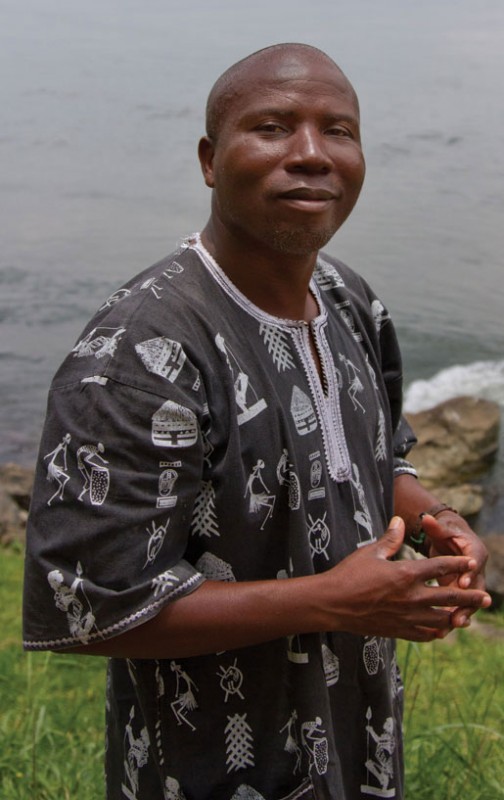 As a first time traveler to Uganda, one is first struck by the tropical sun’s brightness and the thousands upon thousands of people busily engaged in performing their daily tasks. These scenes play out all along the road, from a peasant woman tasked to sweep the dusty roads all day or, as in my case, witnessing the dedication of the staff at the USAID UNITY project. Among them, I had the delight of working with Lawrence Ndagije, the project’s driver, sometime photographer and administrative assistant.
We are seated at an outdoor table at the Serena Hotel in Kampala struggling to speak above the deafening croaks of frogs and crickets. It strikes me that Lawrence has achieved a level of awareness about himself and the world that others might envy. He is one who looks forward, always forward, to a better tomorrow. “I am a survivor,” says Lawrence adding that his name means “God is my Savior.”
As an eight year old in his native Kisoro, Lawrence witnessed an unprecedented spectacle. One day, he heard the sky above him began to clank and whizz with the sound of choppers on the outskirts of town. Idi Amin’s soldiers had arrived to train as parachutists. Lawrence watched in awe as the men in parachutes came down from the sky. He too wanted to experience falling from the sky and before long had an idea. The next day he found a tall tree, climbed up it with an umbrella and jumped. “It was my fortune that someone had been digging the ground and had left a soft mountain of soil, so I survived the fall without breaking my legs.” Ironically, that incident has been something of a metaphor for his life.
Kisoro is in Western Uganda and as Lawrence is fond of noting his home region is green and dotted with terraces where peas, Irish potatoes, bamboo and many things are grown. “We have three mountains, lakes and gorillas. [Overall] Uganda is very beautiful. It has ten climates, people are friendly and it is a place where investments bring profits for Ugandans are hard working people.”
The eleventh of twelve children, Lawrence and his wife today are parents to five children. “My father was loved by all the villagers. He taught me to love people and to be honest. Even now, if I see something that is not right I will question it. It can be a problem to tell the truth, it may hurt you. But, in certain circumstances particularly those in which injustice is perpetrated on those least able to defend themselves, then it is necessary to speak truth to power.”
Often in high spirits tinged with a bit of anxiety, Lawrence takes his position as driver for the UNITY staff with utmost seriousness. He is a professional whose job performance is rated at nearly “99 percent” for consistent service to USAID’s BEPS Uganda project and UNITY, both projects implemented by Creative.
Navigating the streets of Kampala is no small feat. Except perhaps on a Sunday, the traffic is incessant all week long. A driver must negotiate endless traffic jams along with hundreds of mopeds, bicyclists and pedestrians all vying for the same space and with very few traffic lights. A persistent question for visitors in Kampala is how to find one’s way amid the maddeningly chaotic traffic while navigating to find an address in a sprawling city with so few street signs to guide either drivers or pedestrians. “Driving in Kampala is very stressful. A driver’s head must be like a computer, he must make sure his mind works within seconds,” says Lawrence. “But I like being a driver, a driver is someone who keeps all secrets and cannot reveal them. A driver hears and sees a lot. Thank God, I know the roads, I know even the potholes, when a U.S. team comes, they ask for Lawrence.”
Always planning for tomorrow, Lawrence is already thinking about how he will occupy himself when he retires from driving in a decade or so. “You see I have colleagues who are still driving at 55-60 years old, that’s poor planning,” says Lawrence. “When I retire, I will do something else. I am saving money now to start a small clinic with my son-in-law who is in medicine. If that does not work out, I plan to open a hardware store.”
According to Lawrence his time spent as an employee of Creative has been a good experience. “Creative and its partners helped Uganda achieve international standards in our schools by training our teachers and putting in place policies for improving our education system.” Remarking on the imminent closing of the UNITY project in January 2012, Lawrence laments the project’s ending. “We have good [educational] materials from UNITY. We began working with a Special Needs Education policy, PIASCY is still going on, child-led activities. Project partners also supported Creative’s leadership. The credibility factor is significant in a country like Uganda where tribal patronage and nepotism erode confidence due to high corruption. BEPS and UNITY have stood above other projects because its workforce comes from different regions of the country. It’s not a family project with everyone from the one tribe. A diverse staff is key to the success of these projects.”
As a young man, Lawrence made his way to Kampala from Western Uganda, like thousands of others migrating to the city from rural areas. A self-starter, Lawrence earned his driving permit in 1984. He notes that he has driven ministers and commissioners, even the Prime Minister of Uganda. “Each and every group I drove had children in secondary school. I would see them at lunch with their families, see their children, and I felt I had to do something for my children. I have dreams for my children. So, I worked very hard, sometimes with little to eat, so that I could send my children to better schools.”
His three oldest daughters have graduated from college; his fourth daughter is currently in high school. Lawrence’s “lovely” son Benedict is four years old. “I named him Benedict because of the pope – I liked Benedict when I saw a photo of all the potential popes, I picked Benedict and he was elected pope. God blessed me with my own Benedict.”[/vc_column_text][/vc_column][vc_column width=”1/12″][/vc_column][vc_column width=”1/4″][vc_widget_sidebar sidebar_id=”sidebar-primary”][/vc_column][/vc_row]
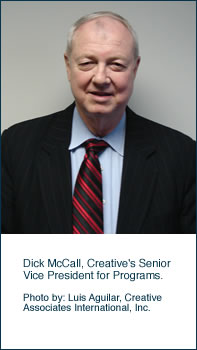 Rebuilding failed states requires a good dose of diplomacy, but without effective institutions to ensure the rule of law and an engaged citizenry, the efforts are doomed to fail, says Dick McCall, Creative’s Senior Vice President for Programs.
 In April, the World Bank released its much awaited World Development Report (WDR) 2011, the influential trend-setter for development. Notably, the Report diverges from the Bank’s previously narrow focus on economics, which until now served as the underpinning of international development goals, especially that of alleviating poverty. That said, poverty remains an intractable development problem. The Report states that some 1.5 billion people are stuck in a “poverty trap” that is fueled by conflict, violence and ineffective governance. While the number of civil wars has diminished, violence and conflict are still widely a perennial occurrence that roots 1 in 4 people on the planet in an unending cycle of poverty. The recurrent nature of violence hampers economic development, security and justice in affected states leaving them incapable of achieving not even one of the UN’s Millennium Development Goals. Perhaps the million dollar question is how is it possible in 2011 that piracy – a problem of the pre-industrial era – persists as a result of the lack of opportunity created by the vacuum of a failed state. Still, the Report highlights that rather than discounting the development community’s efforts of the last six decades as a quixotic quest, it is more productive to look upon and put into practice the hard lessons learned by the sector so that it can better serve the underserved. Creative magazine interviews the World Bank’s Stephen N. Ndegwa, Adviser, Fragile and Conflict-Affected Situations Unit and Core Team Member of the WDR 2011, on the critical shift in thinking about international development that the WDR proposes.
 This is a hard one, because one of the things we push for is first to understand very well the political context and second to assess the capacity of institutions to foster a climate in which decision makers are accountable to citizens and civic groups who in turn recognize and accepts their legitimacy to make and implement decisions for the public good. The triggers for conflict could and/or would be varied in different circumstances. A country with fairly robust institutions in economic management and resource allocations is less likely to provoke citizens into violent reactions although inequality exists among citizens. Take for example the disputed 2000 elections in the U.S. A similar dispute would trigger massive fragility in half the countries in the world. But in the U.S., 250 years after independence, a peaceful resolution put an end to the crisis in a matter of days without shaking the system whose institutions are very, very, very robust. Now, imagine this situation in a country that’s only been in existence for 50 years, has deep ethnic or regional divisions where party affiliations is determined according to one’s membership in specific ethnic or religious groups. So, to design a water project in such a place we want to look at local institutions available to resolve conflicts that may arise if one or more groups perceive that access to water is distributed unequally because distribution is based on discriminatory practices related to ethnic or religious identification. So, if government doesn’t provide security, vigilante groups arise and they tend to ossify into gangs later on. The point is design is context specific and thus the need to examine the institutions in place in order to understand in real time and in historical terms their legitimacy to administer development programs so that aid recipients will not resort to violence to resolve potential conflicts.
 Creative Associates International congratulates USAID for 50 years of hard work on behalf of the American people in battling hunger, poverty, desperation and conflict in the developing world, giving literally millions hope for a better future.